

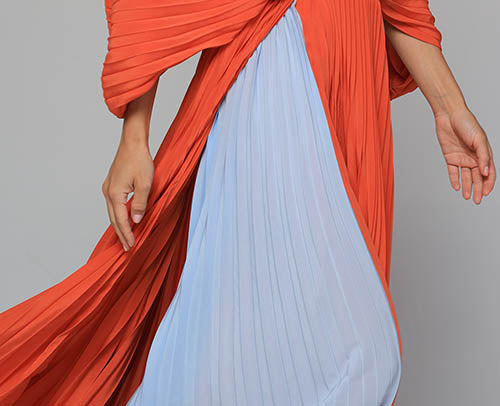
The Art of Pleating: Movement Woven Into Form

Pleating changes the way fabric behaves.
A flat surface becomes dimensional. A silhouette expands and contracts. Colour and artwork can appear, disappear and shift as the wearer moves.
At L’MANE, this transformation is what makes pleating particularly compelling.
FORM CREATED THROUGH FOLD
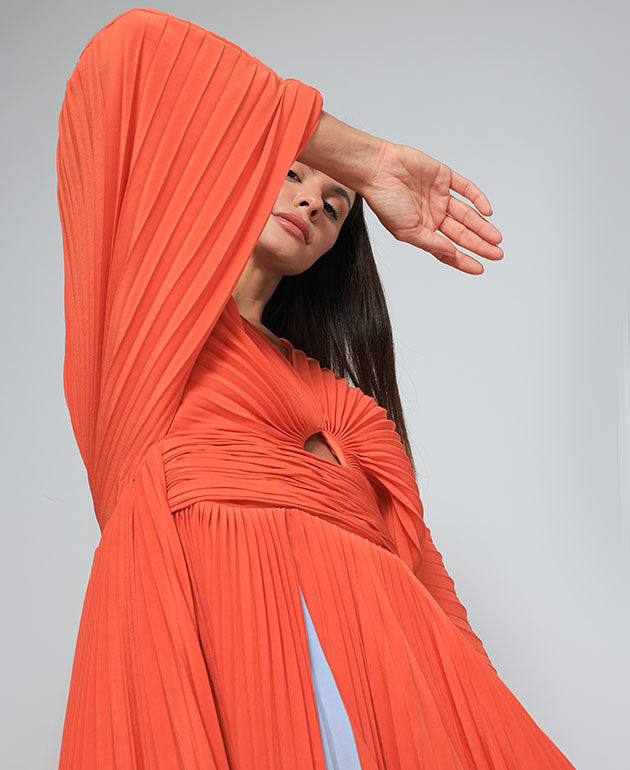
Every pleat begins with fabric, but folding and setting it introduces structure without necessarily adding weight.
The precision of the folds can control volume, change proportion and give a garment its own rhythm. What appears fluid when worn is shaped by a process that requires accuracy and attention to detail.
For us, pleating is not simply a decorative finish. It becomes part of the construction of the garment itself.
DESIGNED TO CHANGE IN MOTION
A pleated garment is never completely static.
As the body moves, the folds open and close. The silhouette becomes fuller and then more restrained. Light moves differently across the surface, revealing depth that may not be visible when the garment is still.
This relationship between form and movement is central to the way we design at L’MANE.

ARTWORK WITH ANOTHER DIMENSION
Pleating becomes particularly interesting when it meets L’MANE’s original artwork.
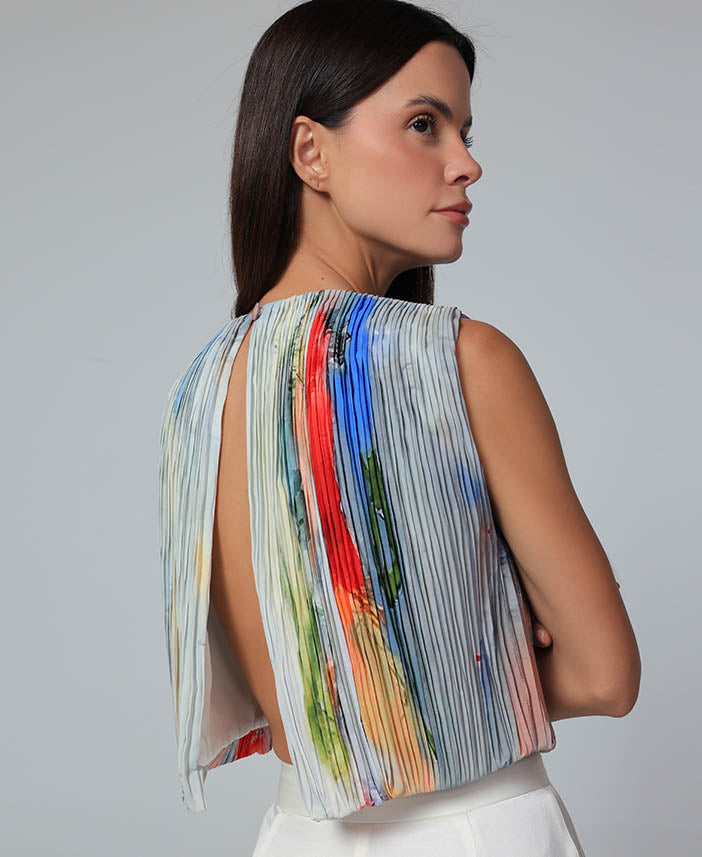
An abstract print placed across a pleated surface is no longer experienced as a flat image. Parts of the artwork can disappear inside a fold and return with movement. Colours meet, separate and change depending on the angle from which the garment is viewed.
The artwork becomes part of the construction rather than something simply placed onto the fabric.
PRECISION BEHIND FLUIDITY
The ease of a finished pleated garment can hide the precision required to create it.
Each fold affects the next. Scale, spacing, fabric and placement all influence how the finished garment will fall and move.
It is this contrast that continues to draw us to the technique: precision creating fluidity, structure creating movement.
For L’MANE, pleating is more than a recurring design detail. It is one of the ways we explore the relationship between art, form and movement — allowing a garment to reveal something different with every step.
The form is created in the fold. The final expression happens in motion.